Polygnotos in Delphi
oil on canvas (cotton)
90 × 120 cm
March 2026
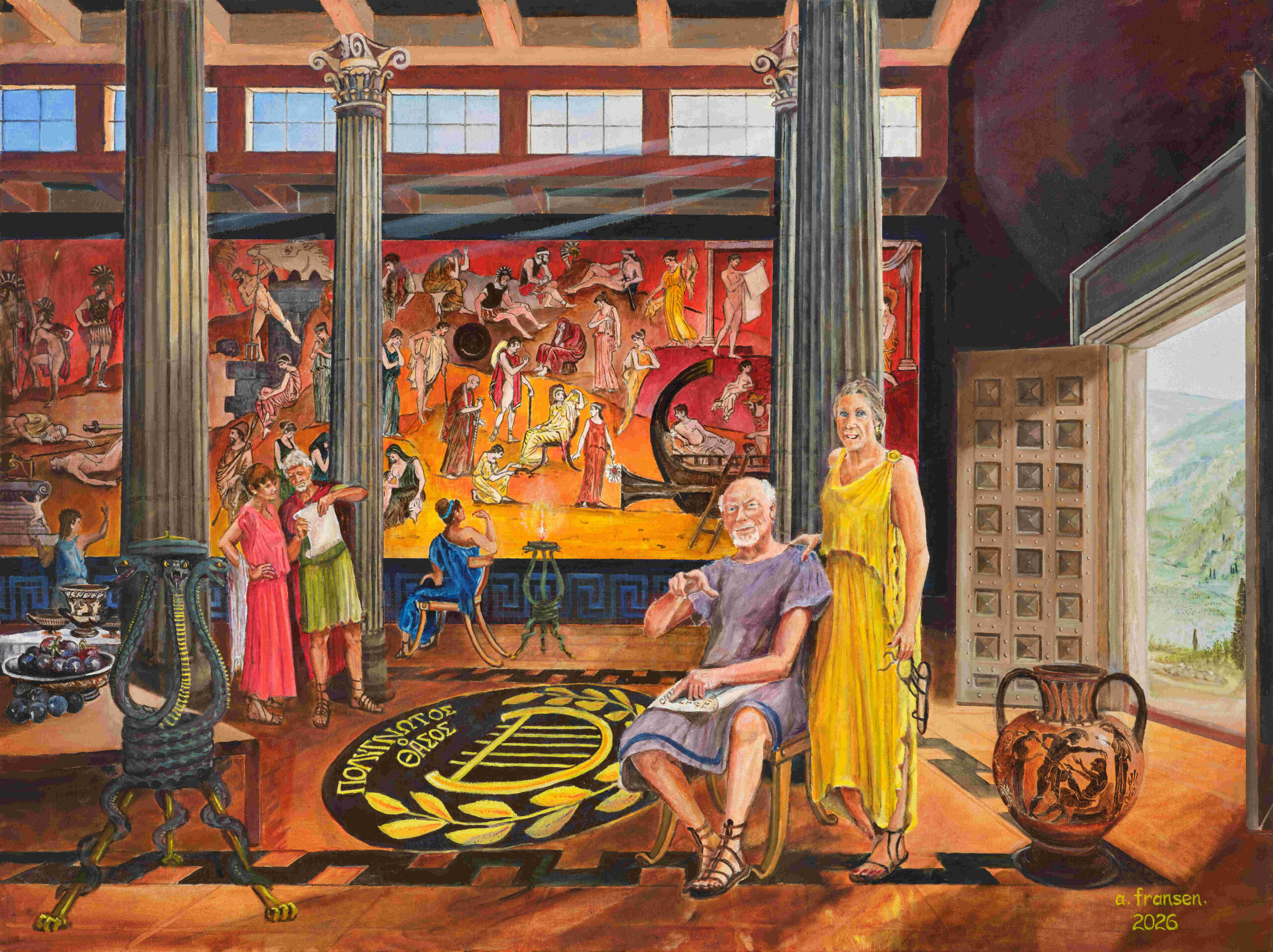
This painting is a tribute to the painter Polygnotos of Thasos. He lived and worked during the first half of the fifth century BC. Nothing has survived except stories about him and, it is believed, echoes of his work in Greek vase painting.
Reminiscences:
- The Second Waltz by Dimitri Shostakovitch (Johan Strauss Orkest conducted by André Rieu)
- Benedictus from The Armed Man by Karl Jenkins (Christian Mindfulness & Revive us Again Ministries)
» Read more
Through his work in Athens, Polygnotos became friends with Kimon, and even more so with Elpenice, son and daughter of Miltiades (the hero of Marathon in 490 BC), respectively.
His commissions likely stemmed from the prevailing euphoria following the Persian defeats and the development of the world’s first democracy under Pericles. A piquant detail is that this statesman was openly criticized by Elpenice, apparently a woman of stature.
My painting is about his most famous work; two gigantic wall paintings (probably frescoes) in the Lesche of the Knidiens in Delphi, created around 460 BC. Upon entering this “clubhouse,” the Ilioupersis was located on the right, and opposite it, on the left wall, the Nekyia. These paintings were described with extreme precision some half a millennium later by Pausanias in his book 10, chapter 25. Those descriptions were used for drawn reconstructions by the painter Hermann Schenck (1829-1912) based on an extensive study by Carl Robert in 1893 of the translation from Greek into French by an abbot named Gedoyn in 1731. We are here in that Lesche, which no longer exists either, with the Ilioupersis, or the Fall of Troy, in the background, almost exactly according to that drawing by Hermann Schenck.
Once, as an imaginary visitor together with Liesbeth and friends, I point to a fragment in the Nekyia. For example, to the moment when Odysseus, having descended into the underworld, actually meets the legendary seer Theresias, hoping that he can tell him the shortest route home, to Ithaca. Behind us, we see part of the right section of the Ilioupersis, primarily depicting the disastrous consequences of war, represented by the desolate posture of abducted women and children during the embarkation. In the center sits Helen, true to her leading role. Her fate remains uncertain. Presumably, she realizes that the war was not actually just about her…….
This mythical European primeval war at the beginning of the 12th century BC is described in Homer’s world-famous Iliad. It contains all the elements that we see reflected in European literature and art history to this day: “For edification and entertainment”.
Unfortunately, as becomes clear time and again, more for entertainment than for edification!!
» Read less